

Muslim Ayodhya: city of mosques, mazars and graves
By Mumtaz Alam Falahi, TwoCircles.net,
TwoCircles.net series: Ayodhya 2009
I am on way to Ayodhya – popularized as a city of temples. Oblivious of what I will see on the way and in Ayodhya will question this qualifier of the city, I am sitting in the autorickshaw running on the six-kilometre Faizabad-Ayodhya stretch, thinking of the city and Hindu mythological stories attached to it. No mosque was even in my imagination. So naturally I was surprised when I came across a small, old but colored mosque, indicating it is alive. To be sure of what I saw was a mosque I turned my head back and continued to see it till it became distant. This was just the beginning.
The six-kilometre stretch is dotted with about 12 mosques, besides several dozen others in the villages and mohallas lying on either side of the single road connecting the twin cities of Faizabad and Ayodhya. Most of these mosques are small and old.
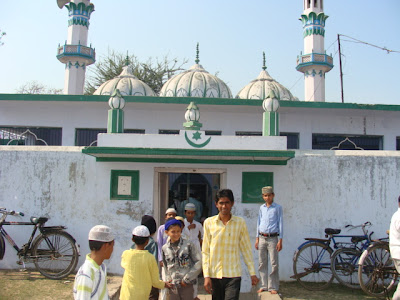
Tehri Bazar Mosque
There are about 103 mosques in the city of Ayodhya of 1.5 lakh population with Muslims constituting 6%. Of these, 35 mosques are alive where 5-time prayer is offered; at 10-15 mosques, Juma Prayer is also offered. The rest are deserted for lack of presence of Muslims in the locality, says Abdul Lateef, an Ayodhya resident, and a voluntary guide for me.
This is Tehri Bazar Mosque, the nearest live mosque from the Babri Masjid-Ramjanambhoomi disputed site, in Tehri Qaziana mohalla. Besides five-time prayer Juma is also offered here. Some of its minarets were also demolished on 6th December 1992 by the Hindutva extremists.
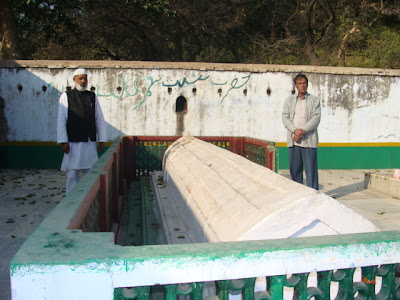
Grave of Hazrat Shis pbuh
You can find some old, deserted mosques adjoining the boundary wall of the acquired 67 acre land of Babri Masjid site.
And this is Hazrat Shis Jinnati Masjid in the 40 acre Muslim graveyard, hardly 1 kilometre from Hanuman Garhi. Juma is also offered here.
In the 40-acre graveyard, said to be the largest in India, there are hundreds of graves, old and new. What makes it famous is the presence of about 12 ft long grave popularly known as that of Prophet Shis (PBUH). This grave is in a walled complex which has about half a dozen other graves also – some of them with grave stones on which are encrypted names and some details about the dead.
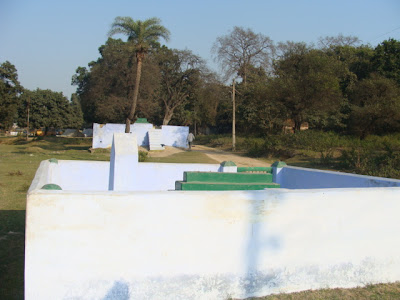
A mazar
Muhammad Kaleem and Kamal Ahmad take care of the grave of Hazrat Shis and other graves in the campus. Locals say people come from far and wide to see the grave of Hazrat Shis.
Besides, you can find several graves, mazars and mosques across Ayodhya. Many of the mosques are roofless, and so called as Qanati Masjid. Many of them are more than 200 years old.
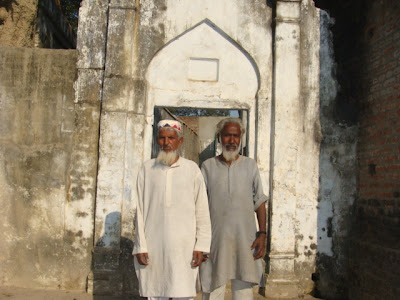
Md Kaleem and Kamal Ahmad take care of the graveyard
Despite so many mosques standing intact, pain of the demolition of Babri Masjid still can be felt when you come to talk to local Muslims. Nemat Ali, a rickshawpuller of Makkhapur village, has not forgot the painful day. Nor has the Imam of the mosque in Ranopali village, two kilometers from Hanuman Garhi.
In the dim candle light the Imam with six people behind him is offering Isha prayer in the mosque of dark Ranopali village of 18 Muslim homes. At the end, he raises hands and prays: O, God, protect us and our mosques from enemies. O, God, pave ways for reconstruction of Babri Masjid at its site. Amen!
Read:
Ayodhya's forgotten Muslim past: http://www.indianmuslims.info/articles/yoginder_sikand/articles/ayodhya_...
FREE REPRINTS
Unless otherwise noted, you can republish our articles for free. You just have to credit TwoCircles.net and link it back to us, and you can’t edit our material or sell it separately. (We're licensed under Creative Commons, which provides the legal details.). For publishing TwoCircles.net photos please contact info@twocircles.net.


thanks
THANKS DEAR FOR MAKING PEOPLE AWARE THAT WE AND OUR MOSQUES ARE STILL ALIVE IN AYODHYA AFTER THAT PAINFULL DEMOLISION.......... WE CAN FORGET............... INSALLAH WE WILL AGAIN OFFER NAMAZ OVER THERE
......................................... WE ARE STILL ALIVE...... we have no problem with ram mandir but we want to reclaim our land......... dear thanks again......
Summary Of Archaelogical Evidence:Ayodhya
Summary Of Archaelogical Evidence:
1. The Babri structure had 14 pillars made of 'Kasauti' black stone with Hindu images. Also inside the Babri compound was a piece of a door jamb with images of 'Mukut-dhari Dwarpal' and 'Devakanyas'. Iconographical evaluation of these pillars and the door jamb by Dr. S. P. Gupta (former Director of Allahabad Museum) showed that these belonged to a Hindu temple of the 11 th Century A.D. period when the Garhwal Kings of Kanauj ruled Ayodhya.
2. Between 1975 and 1980 Prof. B. B. Lal (the then Director General of Archaeological Survey of India) conducted an excavation behind the Babri structure and even touching it. The excavation showed pillar bases of burnt bricks (of the preexisting temple). The most beautiful pottery dated around 8 th-9th Century B.C. was also found.
3. On June 18 th 1992, when the ground near the Ram Janma Bhoomi was being levelled, at a depth of 12 ft, several beautifully carved buff sandstone objects were found. These objects included images of Vaishnav divinities with one 'Chakrapurush' sculpture also showing 'Parashuram' and 'Balram', an image of 'Shiv-Parvati' (largely broken) and many carved stones such as corner were terrecotta Hindu images of Kushan period (1 st to 3 rd Century A.D.).
These and other objects found during subsequent excavations during July 1992, were found to be members of a Hindu temple complex of about 11 th Century A.D. by a team of 8 eminent archaeologists and historians. The team included Dr. Y. D. Sharma, former Deputy Director General of Archaeological Survey of India, and Prof. B. R. Grover, Director of Indian Council for Historical Research.
4. The destruction of Babri structure on Dec. 6, 1992 revealed many archaeological remains which irrefutably prove that Mir Baqi had incorporated parts of the preexisting temple in the construction of the Babri mosque. The remains include a temple bell, several intricate and detailed carvings, an image of Vishnu, and several other Hindu images.
The principal amongst the findings however is a 2 ft wide by 4.5 ft long buff sandstone tablet 'SHILA LEKH' bearing an inscription in 'Devanagari' script and Sanskrit language. The 'Shila lekh' describes an ancient Ram Mandir existing at Ram Janma Bhoomi at least since the 12 th Century A.D. which was built by a Garhwal king Raja Govindachandra.
The 4 th line of this 'Shila lekh' specifically describes a temple of Lord Vishnu (Hari) at the 'Janma Bhoomi Sthal'. The 15 th line describes it as a massive, magnificent temple dominating the landscape, and with steeples 'shikhar' adorned with gold 'Kalash'. The 17 th line specifically mentions the location as Ayodhya and the 'Saket Mandal', while the 19 th line mentions the 'Vaman Avatar' and then mentions Ram as the destroyer of evil Ravan. net, it was a temple! Brief History - 1528 thru 1934 :
As per historians, since 1528 there have been at least 76 armed conflict in which over 300,000 Hindus sacrificed their lives to restore the Ram Janma Bhoomi temple.
Reply to fake Summary Of Archaelogical Evidence:
@Atul
You have written the RSS version of ASI information.
The court has taken cognisance of the report but the ASI findings are defective. The ASI simply says that there was a 12th century structure of a non-residential building under the mosque. The ASI found a wall built in two phases — first pre-12th century and subsequently in the 12th or 13th century. Babri Masjid Action Lawyer have argued that 1190 AD was the begining of Muslim period in Ayodhya and the Muslim kingdom was established in 1206 and the Hindu kingdom ended in 1196.
So if we believe that this wall can’t be of any temple... who would have built a temple then. Lawyer have argued that this could be the wall of an Eidgah.
No statue was found at the site. All the structures found by the ASI were either at the surface or from the debris (of the destroyed mosque). Under the Indian archaelogy laws, no period can be attached to anything found on the surface or in form of debris. The ASI, however, contended that the structure resembled a 12th century Hindu temple but refrained from categorically describing it as a temple. The ASI said it was a non-residential structure. The ASI also found some animal bones and we believe that there is no place for bones in a Hindu temple. Our archaeologists who were produced in the court as witneseses on behalf of Muslims testified that the bones belonged to animals that were eaten by humans. All these archaeologists who testified from Babri Masjid side were Hindus. The ASI is silent on the bones.
The Babri mosque was not constructed after demolishing any temple. And this is not the birth place of Ram. Because the Hindus themselves never believed this to be Ram’s birthsite till the 19th century. In 1885, the head priest of Janmsthan [Ram’s birthplace] filed a suit. Janmsthan refers to an elevated courtyard located in the outer portion of the mosque.
In a site plan filed along with that suit, the Hindu priest identified the building as a mosque. This document is still available in court records. This is one of the most important pieces of evidence produced by us proving that till 1885 Hindus did not call the mosque as the birth place of Ram. During the hearing of that case in 1886, a judge visited the site and he said it was very unfortunate that the mosque was construcetd in that spot but added that Hindus believed that an elevated courtyard outside the mosque was the birthplace of Ram. In 1941, two rival Hindu priests of a group known as Nirmohi Akhara went to court against each other over a property dispute. They also identified the Nirmohi Akhara property as the birthplace of Ram. Papers submitted by the two showed the mosque on the west side of the property. So up to 1941, Hindus never claimed that Ram’s birthplace was located at the mosque site.
The judgement
The High Court has given its verdict! I think, it is the best of its kind, however the unsatisfied parties are always at their liberty to appeal the SC. May what be, we have always lived together happily before these opportunist British Officers came to India. How could we let some people manipulate our conscience!
I hope that we are mature enough to understand that India is a secular country with equal rights to each and every religion and showing respect to the spirit of our nation, we should avoid any such act which spreads communal restlessness. Just see one of the pic in Unity Circle: H_ND_ & M_SL_M Can u see the similarity!
We are all human with the same blood, same bones and same DNA... where's the difference?
Babri Masjid
Good Work TC.net,keep it up and keep doing the good work of educating the people of India, mostly the Muslims who are way behind in all fields of life.They are not aware of their condition in India, some don't want to know, but its over duty to educate, awaken and empower them and Inshallah Allah will reward u for the great work.
good knowledge for Muslim of
good knowledge for Muslim of the other country
Shish (ASW) PBUH
Good job TCN. Great series with full of information and reality and truth.
This is amazing. I heared about the grave of Shish ASW (PBUH) in Ayodhya from my childhood and keep forgetting to ask some learned person about the authenticity of the grave. As per my little knowledge of Islam and Shish ASW is the second prophet after Adam ASW (PBUH) and if if his grave is in India then the theory of Adam's peak in Sri Lanka may be close to the truth of Adam's fall to this world around Indian subcontinent.
Lets do some research and share the thoughts.
Regards.
Hi
The grave of Prophet Noah is also in Ayodhya. According to Ramayan Sri Ram belongs to Ikshvaku dynasty. The progenitor of Iskhvaku (Suryavanshi dynasty) and the first king of Ayodhya according to Ramayan is "Manu". Some Islamic scholars have said that Manu/Noah are the same. Both faced the flood.
The Tamil(Dravidian) Sangam literature says that Manu Maharaja came from Sri Lanka after floods to Ayodhya. Ancient Tamil Dynasty of Chola Kings also claims descent from Ikashvaku family.
The Adam's bridge/ Sri Ram sethu, Sripada mountain or Adam's peak(mentioned in "Aditya Hridaya" of Ramayan) as well as Ayodhya on Sarayu river are connected.
I am not guessing but it would be nice to know ancient Islamic / Arabic /Sanskrit and Tamil sources. I am sure that India is a very old civilization in anycase. We must not however fight over religion/language etc.
Post new comment